
The Complete Guide to Navratri & Garba Stage Design for International Events
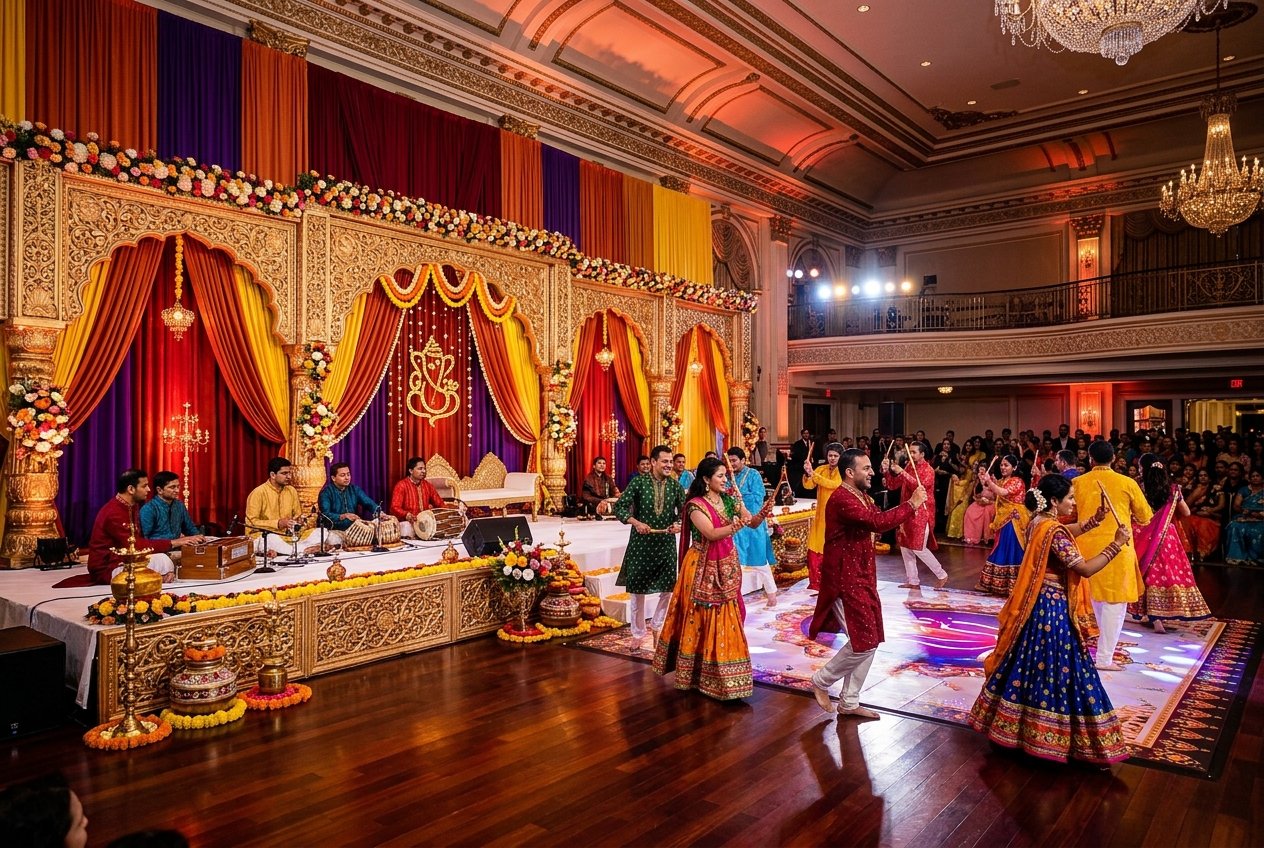
Every year, Gujarati and broader Indian associations across Toronto, New Jersey, Leicester, Sydney and Auckland put on Garba nights that rival anything in Gujarat for energy — but rarely for stage design. Not because the budgets aren't there, but because most organizers are working from decade-old templates: a banner backdrop, a rented truss, some marigold garlands. Meanwhile the venues themselves — convention centres, university gymnasiums, banquet halls — are more demanding than an open ground in India, with fixed ceilings, load-in windows and fire codes that a decorative structure has to work within.
This guide is written for the people actually responsible for that stage: cultural association committees, Gujarati and Hindu organization event leads, professional event companies serving the diaspora, university student associations, and temple and cultural-centre planners across Canada, the USA, the UK, Australia and New Zealand. It walks through the full journey — from understanding the venue environment through to shipping, installation and reuse — as a genuine end-to-end planning resource, not a list of decoration ideas.
1. Understanding the International Navratri Event Environment
Outside India, Navratri and Garba events happen in a much wider range of venue types, and each one imposes different design constraints:
| Venue Type | Typical Constraint | Design Implication |
|---|---|---|
| Indoor banquet halls | Fixed ceiling height, carpeted or finished floors | Structure height capped; floor-protective bases needed |
| Convention centres | Strict load-in/load-out windows, fire-marshal material rules | Fast-assembly modular components, fire-rated fabrics |
| Community halls | Smaller footprint, limited storage on-site | Compact, foldable/knock-down structure |
| Sports arenas / gymnasiums | Very high ceilings, hard court flooring | Taller sightline-friendly design; non-marking floor protection |
| University campuses | Shared-use spaces, tight setup time between other bookings | Rapid setup/breakdown, lightweight components |
| Outdoor events | Weather variability, permit and wind-load rules | Weather-resistant materials, secured anchoring |
On top of venue variation, the audience itself is different from a typical Indian ground event — mixed generations, mixed cultural familiarity (many second-generation attendees and non-Indian guests), and often a stronger expectation of polished production values shaped by Western event standards. Add to that the practical realities of transportation, local venue regulations on decor materials, and where the structure will actually be stored between events, and it's clear why a design that works well on an open ground in Gujarat often needs real rethinking for a hall in Mississauga or Milton Keynes.
2. Pre-Navratri and Welcome Navratri Events
One of the fastest-growing parts of the international Navratri calendar is the event before the event — Pre-Navratri gatherings, Welcome Navratri ceremonies, season launch nights, sponsor previews and cultural-association member gatherings. These matter more than their smaller scale suggests: they're often the first, most-photographed touchpoint of the season, they set expectations for the main nights, and they're frequently the event sponsors and media actually attend.
These events typically don't need — and shouldn't be built around — a full performance-scale stage. What they do need is different:
- Smaller, high-impact stages: A compact structure that reads as polished and complete, not a scaled-down version of the main-night stage.
- Photo backdrops: A dedicated, well-lit backdrop built specifically for portraits and group photos, separate from any performance area.
- Welcome installations: A standalone decorative piece at the entrance that photographs well and signals the season has begun.
- Cultural entrance décor: Torans, floral arches or gate-style installations that frame the arrival moment.
- Brandable event spaces: Clean surfaces designed to carry sponsor or association branding for media coverage.
- Social-media-friendly installations: Structures specifically composed for phone photography — good depth, good lighting, minimal background clutter.
- Flexible, reusable structures: Since these events happen earlier and smaller, components should ideally roll forward into the main Navratri stage build rather than being a one-off spend.
3. The Complete A-to-Z Navratri Stage Design Process
Treat this as a genuine planning sequence — each step builds on the one before it, and skipping ahead (starting with decorative theme before venue assessment, for instance) is the most common cause of budget overruns and last-minute redesigns.
Audience & Event Objective
Start with who is attending and why. A university Garba, a multigenerational community celebration, and a sponsor-facing corporate Navratri event all call for different stage scale, tone and formality — define this before any design conversation.
Brand & Cultural Identity
Decide how the association's or event's identity — logo, colours, cultural references — will be woven into the design, and confirm which cultural elements (a Devi focal point, specific regional motifs) are non-negotiable for your community.
Custom Stage Dimensions & Venue Assessment
Get exact venue measurements — length, width, ceiling height, floor type, column obstructions — either from the venue's technical pack or a site visit. This single step prevents more redesigns than any other.
Decorative Layers, Colour & Theme
Choose a design direction (see Section 4) and a colour system that works under the venue's actual lighting conditions, not just in a rendering.
Entry Experience & Stage Positioning
Plan what guests see first — often not the main stage itself but an entrance moment — and position the stage so it doesn't conflict with entry/exit flow or fire-egress requirements.
Functional Zones & Flow
Map performer, DJ, sound and branding zones the same way as for a domestic event (see Blog 1's zone breakdown), adjusted for the hall's fixed layout and any AV vendor requirements.
Glow: Lighting Compatibility
Confirm what lighting the venue allows and provides versus what you'll need to bring — indoor halls often restrict rigging points, haze/fog use, and where trussing can be hung.
Hardware, Modular Planning & Customization
Confirm which components are custom-built for this event and which come from a reusable modular system — this decision directly drives cost and lead time.
Installation Planning
Lock the load-in/load-out schedule against the venue's actual booking window, including how many crew hours the design realistically requires.
Logistics, Packaging & Transportation
Plan how components ship or travel to the venue — crate sizing, weight limits, and a clear inventory list — well before the event date, not the week of.
Photography & Social-Media Design
Walk through the confirmed photography and drone/crane positions (Section 7) and check the design reads well from each one.
Reusability & Post-Event Storage
Decide, before fabrication, where components will be stored after the event and whether they're built to survive a second or third season — this is where modular planning pays off most.
This sequence deliberately skips letters that don't map to a distinct planning decision — the goal is a usable process, not a forced acrostic.
4. Global Design Concepts
These directions are calibrated specifically for international venues and audiences — most combine well with each other depending on the event's formality and scale.
| Concept | Ideal Audience | Best Venue Type | Scalability |
|---|---|---|---|
| Traditional Gujarat-Inspired Garba Stage | Multigenerational community events | Large community halls, gymnasiums | High — scales from 300 to several thousand |
| Contemporary Indian Luxury Stage | Premium and invite-only events | Banquet halls, hotel ballrooms | Medium — best at 300–1,000 guests |
| Global Fusion Navratri Experience | Mixed diaspora and non-Indian guests | Convention centres | High — flexible across formal and casual events |
| Heritage Palace Concept | Sponsor-facing, high-visibility events | Hotel ballrooms, premium venues | Medium — designed for visual density, not sheer scale |
| Modern Temple-Inspired Design | Temple and cultural-centre congregations | Temple halls, cultural centres | Medium-High |
| Minimal Premium Cultural Stage | Design-conscious urban associations | Modern banquet and event spaces | High — easy to scale via repeated modules |
| Large Community Festival Stage | Mass-participation public Garba | Arenas, large open grounds | Very High |
| University Garba Event Design | Student associations, young adult crowd | Campus gymnasiums, student unions | High — fast setup priority over ornamentation |
| Corporate Navratri Celebration | Employee and client-facing events | Convention centres, corporate venues | Medium — branding-forward design |
| Family-Friendly Community Navratri Setup | All-ages community gatherings | Community halls | High |
| Pre-Navratri Welcome Installation | Season-opening, sponsor and media events | Any indoor or outdoor entrance space | High — compact and highly reusable |
5. Customization for International Venues
The right customization approach depends heavily on venue category:
- Small community halls: Prioritize a compact footprint and quick assembly over scale — a well-composed 12-foot stage reads better than an oversized structure crammed into a tight room.
- Large convention centres: Design for scale and sightlines across a wide floor, with fire-rated materials and rigging that meets venue technical requirements.
- Banquet halls: Work within fixed decor and ceiling constraints, often needing floor-protective bases and venue-approved anchoring methods.
- Outdoor grounds: Plan for weather resistance, wind load, and a backup contingency if the event is rained out or moved.
- University venues: Build for very fast setup and breakdown between other campus bookings, with lightweight, easily handled components.
- Temporary event spaces: Favor fully modular, knock-down structures that can be assembled without permanent fixtures.
Because most international organizers don't return to the same venue every year, flexible and reconfigurable design isn't a nice-to-have — it's the difference between a structure that serves five seasons and one that's discarded after its first use.
6. Export-Friendly Planning
For any organizer sourcing a stage or decorative structure from India, planning around shipping and logistics from day one matters as much as the visual design itself. This is a matter of thoughtful project planning, not a compliance claim:
- Modular design: Components engineered as independent units pack, ship and reassemble far more predictably than a single oversized structure.
- Shipping-friendly planning: Confirming crate dimensions and weight early avoids costly freight surprises later.
- Efficient packaging concepts: Nesting, flat-packing and protective packing sequences reduce both cost and damage risk in transit.
- Space-conscious components: Decorative elements designed to disassemble compactly reduce container/volume requirements.
- Reusable structures: A structure engineered to survive multiple shipping cycles is a materially different design brief than a single-use one — flag this requirement upfront.
- Adaptability: Components that can be reconfigured on arrival give organizers flexibility if final venue measurements shift.
- Easier handling: Manageable component weights and sizes mean fewer people and less specialized equipment are needed on installation day.
- Project planning before dispatch: A clear installation guide and labelled component inventory prevents confusion when a local crew — not the original design team — handles setup.
- Clear dimensions and requirements upfront: The single most valuable thing an international organizer can hand a supplier is precise venue dimensions and a firm event date, since both drive the entire shipping timeline.
For organizers new to sourcing from India, our international shipping guide covers the logistics side of this process in more detail.
7. Designing for Photography and Social Media
International Navratri events are documented relentlessly — by attendees, by association media teams, and often by local press covering diaspora cultural events. A stage designed with this in mind should account for:
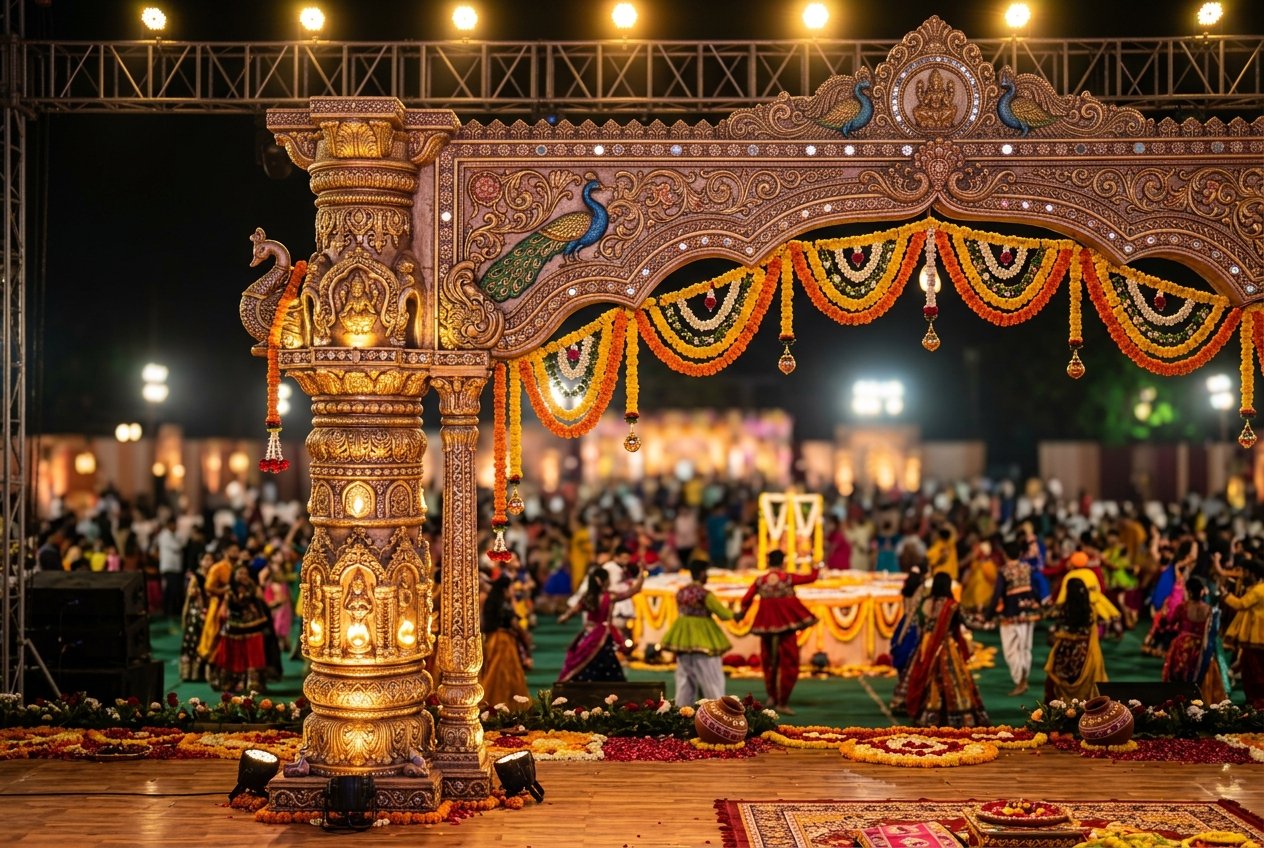
- Entry moments: A composed, well-lit arrival point that gives every guest a natural first photo.
- Backdrop design: Enough visual depth (layered elements, not a flat printed banner) to look intentional in both posed and candid shots.
- Stage depth: Foreground and background elements that separate the subject from the structure in photos, rather than everything reading as one flat plane.
- Dedicated photo zones: A backdrop separate from the performance area so portrait sessions don't interrupt — or get interrupted by — the main program.
- Social-media-friendly composition: Framing and colour choices that hold up well in vertical phone-camera formats, not just wide event photography.
- Community identity and branding: Visual cues that make it instantly clear which association or city's event this is when photos circulate online.
- Day and night appearance: For events that start with daylight still coming through hall windows, check the design reads well in both natural and evening LED lighting.
8. Cultural Authenticity Meets Modern Event Expectations
The strongest international Navratri stages don't choose between cultural authenticity and contemporary production value — they hold both. That means preserving genuine Gujarati design references (traditional motifs, symbolic colours, recognizable decorative elements) while delivering the polish international audiences now expect from any large event: clean modern aesthetics, well-integrated lighting, and production quality that matches — or exceeds — other community and corporate events at the same venue. Getting this balance right is often what separates an event that reads as "impressive" from one that reads as merely "traditional."
9. Country-Specific Considerations
Canada
Large Gujarati and broader South Asian communities in the Greater Toronto Area, Vancouver, Calgary and Edmonton frequently run community-hall and convention-centre events at meaningful scale. Cooler autumn evenings make indoor venues the default, so plan around fixed hall dimensions and storage between the event and the following year rather than open-ground contingencies.
USA
With Navratri celebrated widely across New Jersey, Texas, California, Georgia and beyond, US events range from large arena-scale community celebrations to more intimate cultural-centre gatherings. Venue formats vary widely by region, so confirming ceiling height, load-in access and fire-marshal material requirements early is especially important for convention-centre and school/university venues.
UK
UK Garba and Navratri events, concentrated in cities like Leicester, London, Birmingham and Manchester, often run in community halls and leisure centres with tighter footprints than North American venues. Compact, high-impact modular design tends to outperform oversized structures that don't suit typical UK hall dimensions.
Australia
Australia's Indian diaspora events in Sydney, Melbourne and Brisbane increasingly draw large, multigenerational crowds, with growing university and cultural-association programming. Because Australia's Navratri season sits in the cooler months there, indoor community and function-centre venues are the norm — plan storage and reuse with an eye to the following year's likely venue change.
New Zealand
New Zealand's Indian community events, centred around Auckland and Wellington, tend to be smaller-scale and community-hall based, which makes compact, reusable, high-quality stage design especially valuable — a well-built modular structure can realistically serve several seasons of a growing community's celebrations.
Planning a Navratri or Garba Event Outside India?
Shyam Agencies works with cultural associations, event companies and community organizers on customizable, export-planned stage and decorative structures for Navratri and Garba events. Share your country, venue dimensions, event date, audience size and design direction, and we'll help you scope a design that works for your venue and your logistics.
Start Your Stage Design Conversation10. International Buyer / Event Planner Checklist
Have this ready before your first supplier conversation
- Event type — main Navratri night, Pre-Navratri, Welcome Navratri, or a sponsor/media event?
- Exact venue dimensions, ceiling height and floor type
- Expected audience size at peak attendance
- Indoor or outdoor, and any weather contingency needed
- Core stage requirements — performance platform, DJ zone, photo backdrop, or a combination
- Decorative theme and colour preferences (see Section 4 for starting directions)
- Customization needs — dimensions, cultural elements, regional design references
- Branding and sponsor integration requirements
- Shipping considerations — origin port/city, target delivery window, any customs contact on your side
- Installation plan — available load-in/load-out hours, local crew or labour access
- Storage plan for the structure after the event
- Whether the structure needs to be designed for reuse in a future season or venue
Frequently Asked Questions
How is a Navratri Garba stage design for the USA or Canada different from one in India?
The core design principles are the same, but international events are far more likely to run inside banquet halls, convention centres or gymnasiums with fixed ceiling heights, load restrictions, and strict load-in/load-out windows. That usually means a scaled-down but still visually complete structure, shipping-friendly modular components, and lighting designed for indoor rigs rather than open-ground trussing.
What is a Welcome Navratri or Pre-Navratri event, and does it need a full stage?
A Welcome Navratri or Pre-Navratri event is a smaller, earlier gathering — often a season-opening ceremony, sponsor event, or community preview — held before the main Navratri nights. It rarely needs a full-scale performance stage, but it does benefit from a high-impact photo backdrop or entrance installation, since these events are often the first, most-photographed touchpoint of the season.
How far ahead should international organizers plan a custom Garba stage?
For a first-time custom design involving international shipping, organizers typically need 10 to 14 weeks of lead time to allow for design finalization, fabrication, transit and a buffer for customs or logistics delays. Organizers reusing a modular system from a previous season can often plan on a shorter 4 to 6 week timeline.
Can the same stage design be reused for multiple years at different venues abroad?
Yes, when the structure is planned as a modular, shippable kit from the outset. Components sized for efficient packing and designed to reconfigure into different footprints can move between a community hall one year and a convention centre the next, which is significantly more practical than a bespoke build-and-discard structure for a single event.
What should an international Garba event organizer prepare before contacting a stage supplier?
Have the venue's exact dimensions and ceiling height, expected audience size, event date, indoor or outdoor setting, any load-in/load-out time restrictions, a rough theme or colour direction, and any branding or sponsor requirements ready. This lets a supplier scope a realistic, customized concept in the first conversation rather than several rounds of back-and-forth.