
Navratri Garba Stage Design: A Professional Framework for Event Decorators
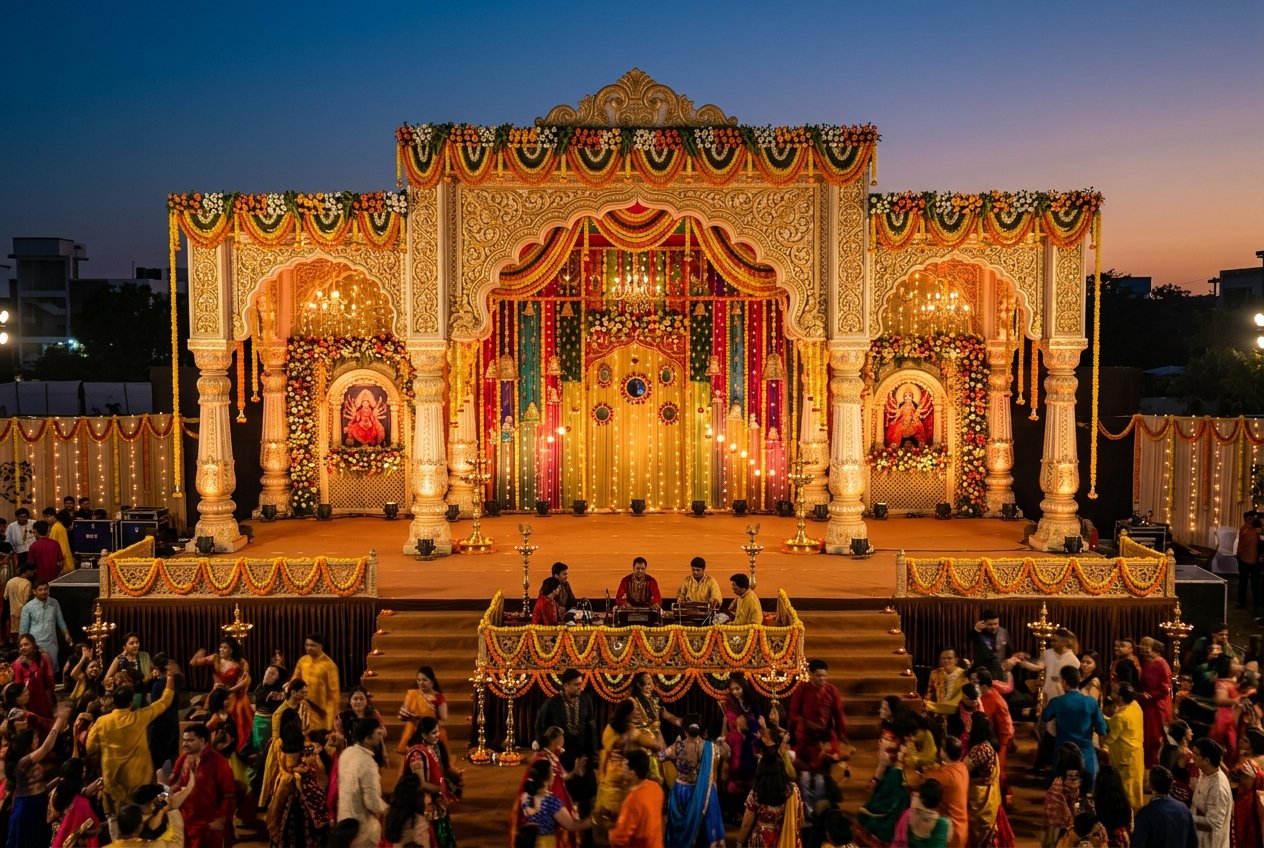
Every experienced Garba organizer has watched the same pattern play out: two events with near-identical budgets, similar music, similar crowd sizes — and one is remembered as the best Garba of the season while the other is forgotten by the following week. The difference is rarely the dandiya sticks or the playlist. It is the stage. In a circular, high-energy format where thousands of people orbit a central structure for three to four hours a night, the stage is not a backdrop to the event — it is the event's visual identity, its photography anchor, and its first impression before a single beat drops.
This is a working reference for event designers, decorators, Garba organizers, community committees, corporate event teams and venue planners who are past the "what theme should we pick" stage and into the harder questions: how a stage is actually structured, zoned, customized and executed across different venues. Nothing here is generic festival content — it's a design and planning framework, written the way a supplier who builds these structures would brief an event team.
1. Why the Stage Has Become the Visual Identity of a Modern Garba Event
Ten years ago, a Garba stage was largely functional — a raised platform for the singer, a backdrop banner, and enough lighting to be seen. That's no longer sufficient for a premium event, and organizers who still treat the stage as an afterthought are visibly behind those who don't. The stage now carries several jobs simultaneously:
- First visual impression: For most attendees, the stage is the first thing they see on entry and the reference point they orient around for the rest of the night.
- Photography and videography anchor: Nearly every professional and phone photo taken at a Garba event either includes the stage or is shot with the stage in the background. A flat, poorly lit structure shows up in every photo — a well-composed one becomes the event's signature image.
- Audience orientation: In a circular dance format, the stage is the fixed point that gives thousands of moving people a shared sense of direction and centre.
- Sponsor visibility: For sponsored events, the stage is the highest-value real estate on the ground — the one surface guaranteed to appear in official photography, live streams and press coverage.
- Performer and artist presentation: Singers, dhol players and DJs need a structure that presents them well on camera and gives them functional space to perform, not just stand.
- Cultural atmosphere: The stage sets the tone — traditional, royal, contemporary, minimal — that the rest of the decor, lighting and even dress code often follows.
- Premium perception: Attendees and sponsors alike read stage quality as a proxy for how seriously an event is organized, well before they experience the music or crowd management.
- Social-media-friendly design: With most attendees recording and posting through the night, a stage designed with depth, layered lighting and a clean focal composition generates organic reach the event doesn't have to pay for.
Once a stage is understood as carrying all of these functions at once, it becomes clear why treating it as a single flat backdrop with some marigold trim is a missed opportunity — and why professional event designers increasingly brief their stage supplier the same way they would brief a set designer.
2. Understanding the Functional Zones of a Large Garba Stage
A well-designed Garba stage is not one surface — it is a composition of zones, each with a different job. Skipping this step is the most common reason large stages end up visually cluttered or functionally awkward once performers, sound equipment and lighting rigs are actually in place.
| Zone | Function | Key Design Consideration |
|---|---|---|
| Main performance platform | Primary singer/host position, ribbon-cutting or inaugural moments | Must read clearly from the farthest point of the ground, not just the front rows |
| DJ / music console zone | DJ setup, mixing console, monitor speakers | Needs a stable, vibration-isolated surface and cable routing separate from the walking path |
| Singer and musician placement | Live vocalists, dhol, tabla, harmonium players | Sightline to the DJ/conductor and enough width to avoid crowding during ensemble numbers |
| Devotional or Durga focal zone | Idol, kalash or symbolic centrepiece where the event includes one | Should read as visually distinct from the performance zone, often slightly elevated or framed separately |
| Central visual backdrop | Primary photography surface and brand/cultural statement | Needs depth (layered elements, not a flat print) and lighting that works after dark |
| Entry-facing composition | What guests see the moment they walk in | Often a different angle than the main performance-facing view — plan both separately |
| Side wings | Secondary decorative structures framing the main stage | Should echo the central theme without competing with it for attention |
| LED / decorative lighting integration | Programmable colour washes, screen backdrops, festoon or fairy-light layers | Plan conduit and power routing into the structure, not as a bolt-on afterthought |
| Sponsor integration area | Branding panels, banners, logo walls | Fixed panel sizes and positions agreed before fabrication, not improvised on-site |
| Photography sightlines | Where official photographers and drone operators will shoot from | Walk the ground (or study the floor plan) from those exact positions before finalizing composition |
| Audience-facing edge | The boundary where the crowd's circular movement meets the stage | Needs a clear, safe edge — barricading or platform lip — that doesn't interrupt sightlines |
| VIP / special viewing zone | Seating or standing area for sponsors, dignitaries, senior committee members | Position for a strong stage view without blocking general audience circulation |
Mapping these zones on paper — even a rough sketch — before approaching a fabricator is the single highest-leverage step in avoiding a stage that looks good in a render but falls apart operationally once the DJ console, barricades and photographers are all fighting for the same eight feet of space. For international events in North America, Europe or Australasia, review our International Navratri & Garba Stage Guide which covers venue-specific constraints for overseas halls.
3. How Professional Event Designers Should Think About Navratri Stage Design
Beyond the zones themselves, a professional brief accounts for the physical and operational realities of the specific venue and event. These are the variables that separate a stage design that survives contact with the real ground from one that only works in a mood board:
- Venue dimensions: Exact ground or hall length, width, and available depth for the stage — not an estimate.
- Ceiling height (indoor): Determines maximum backdrop height, truss clearance, and whether an LED wall or hanging drape is feasible.
- Open-ground vs indoor venue: Open grounds need wind-load-safe structures and weather contingency; indoor halls need fire-safety-compliant materials and load limits respected.
- Audience capacity: A stage sized for 500 attendees reads as undersized and gets visually lost with 3,000 in the ground — scale the structure to expected peak attendance, not average.
- Circular Garba movement: Unlike a frontal-audience event, the crowd moves in continuous rings around the floor — the stage should look intentional from at least 180–270 degrees, not just dead-on.
- Entry and exit flow: Stage placement should not create a bottleneck at the ground's main entry/exit points.
- Visual balance from multiple angles: Check the design from the side and rear, not just the "hero" front-on render most designers default to.
- Day-to-night transformation: Pre-event and early-evening light looks very different from a stage lit at 10 pm — design the lighting layer as its own pass, not an assumption.
- Lighting compatibility: Confirm the structure has planned points for spotlights, uplighting, and LED strip integration rather than relying on ambient event lighting alone.
- Installation and dismantling window: A design that takes two extra days to install against a tight venue-access schedule is not viable regardless of how it looks.
- Storage and transportation: Oversized single-piece structures are expensive and difficult to move; components that break down into transport-friendly modules travel and store far more efficiently.
- Reusability: For organizers running multi-night or multi-venue programs, a structure built for one-time use is a sunk cost — one built modularly pays for itself across seasons.
4. Customization Possibilities
"Customizable" is a word every supplier uses; in practice it should mean specific, controllable variables. A professional stage-decoration partner should be able to adapt a base concept along each of these axes without starting the design from zero:
| Customization Axis | What It Changes |
|---|---|
| Stage dimensions | Width, depth and height scaled to the actual platform and ground/hall size |
| Venue size and shape | Layout reconfigured for square halls, long narrow grounds, or open fields |
| Theme | Royal, temple-inspired, mirror-work, palace, minimal, folk-art and more (see Section 5) |
| Colour palette | Traditional red-gold, white-gold, jewel tones, or community/brand colours |
| Traditional vs contemporary styling | Density and style of ornamentation, from heavily layered heritage motifs to clean minimal lines |
| Premium vs large-scale functional | Balance between decorative richness and sheer capacity to serve a very large crowd |
| Regional preferences | Design references that resonate with the specific community — Kutchi, Saurashtra, Kathiawadi, urban-contemporary Gujarati and others |
| Branding requirements | Sponsor and community-identity integration without disrupting the cultural composition |
| Modular configuration | Reconfiguring the same base components into a different footprint or backdrop shape |
| Decorative layers and depth | Foreground, mid-ground and backdrop elements that create photographic depth instead of a flat surface |
The organizers who get the best results are the ones who come to the first conversation with these variables already thought through — not necessarily decided, but at least named — rather than a single Pinterest image and a budget number.
5. Design Styles Event Professionals Can Explore
These eleven directions are starting points, not fixed packages — most strong Garba stages borrow from two or three of them rather than following one style rigidly.
Royal Gujarati Heritage
Best for: large open grounds, community and temple-organized events. Composition: tall carved-look pillars, layered arch backdrop, deep red and gold palette. Decorative elements: mirror-inlay motifs, brass-tone detailing, heavy drape work. Lighting: warm amber wash with gold accent spotlighting. Audience experience: grandeur and cultural weight, strong for opening-night ceremonies. Ideal event: large community Garba, temple-organized celebrations.
Contemporary Temple Architecture
Best for: mid-to-large venues wanting a devotional focal point without full royal density. Composition: shikhara-inspired tiered backdrop silhouette, symmetrical framing around a central focal zone. Decorative elements: clean carved-panel motifs, restrained gold trim. Lighting: uplighting on the tiered silhouette for a striking after-dark profile. Audience experience: reverence balanced with visual clarity. Ideal event: temple and cultural-organization Garba with a Devi focal point.
Mirror and Reflective Garba Aesthetic
Best for: events prioritizing photography and social-media impact. Composition: mirror-work panels across the backdrop and wings, catching light from multiple angles. Decorative elements: traditional abhla/mirror embroidery patterns rendered at stage scale. Lighting: moving or coloured light that plays across the reflective surface. Audience experience: highly photogenic, especially popular with younger attendees. Ideal event: college, youth-community and destination Garba nights.
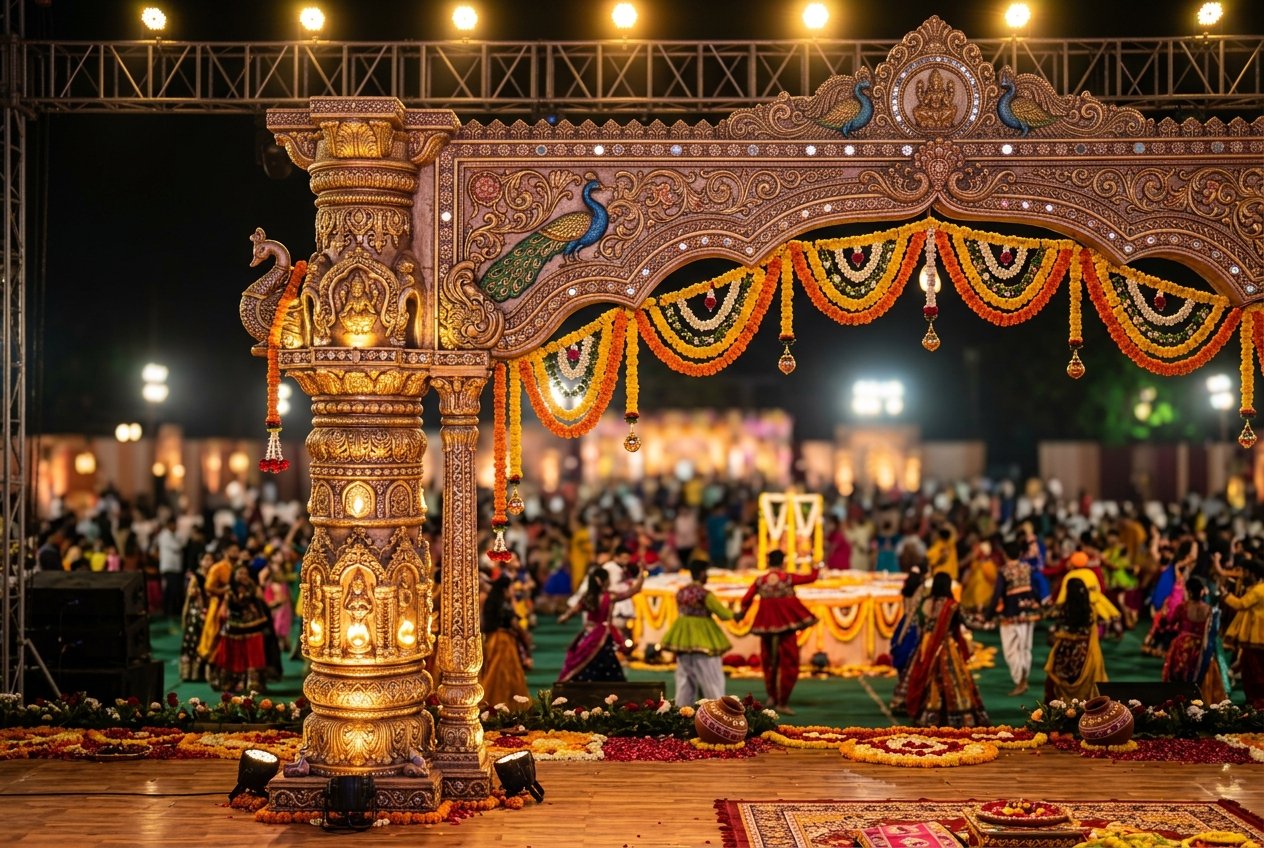
Palace-Inspired Stage Concepts
Best for: premium and invite-only events. Composition: jharokha-style arched openings, layered facade with depth. Decorative elements: latticed jali screens, muted gold-on-cream or gold-on-ivory palette. Lighting: soft architectural uplighting that reads as elegant rather than loud. Audience experience: refined, "premium venue" perception from the first glance. Ideal event: corporate Navratri celebrations, five-star venue Garba.
Modern Minimal Luxury Garba
Best for: contemporary banquet halls and urban audiences. Composition: clean geometric backdrop, negative space used deliberately. Decorative elements: a small number of high-impact pieces rather than dense ornamentation. Lighting: precise spotlighting and colour-block LED washes. Audience experience: feels current and design-forward rather than traditional-heavy. Ideal event: urban housing-society Garba, younger-demographic community events.
Traditional Red and Gold Grandeur
Best for: classic large-scale Garba where organizers want an unmistakably festive register. Composition: full-width backdrop with layered drapery and pillar framing. Decorative elements: marigold and traditional floral motifs alongside gold trim. Lighting: warm, saturated colour wash. Audience experience: instantly reads as festive and celebratory. Ideal event: mass-participation community Garba.
White and Gold Cultural Elegance
Best for: events wanting a premium, photograph-friendly palette that isn't heavy. Composition: light backdrop base with gold-line detailing. Decorative elements: restrained floral or geometric gold accents. Lighting: reads exceptionally well under both daylight and evening LED. Audience experience: elegant without visual fatigue over a multi-hour event. Ideal event: premium societies, sponsor-heavy events needing branding to stand out cleanly.
Vibrant Multicolour Community Garba
Best for: large, high-energy public events. Composition: bold colour-blocked backdrop panels. Decorative elements: multicoloured bandhani- and leheriya-inspired patterns. Lighting: dynamic colour-changing LED to match the palette's energy. Audience experience: high-energy, celebratory, strongly photogenic in daylight and at night. Ideal event: public grounds, multi-night mass-participation Garba.
Textile-Inspired Decorative Architecture
Best for: organizers wanting a distinctly Gujarati handcraft identity. Composition: structure built to echo textile patterns — bandhani, patola, ajrakh — at architectural scale. Decorative elements: fabric-draped panels, embroidered-look trims. Lighting: soft wash that lets pattern and texture read clearly. Audience experience: a distinctly craft-forward, culturally rooted identity. Ideal event: heritage-focused community and NRI-connect events.
Geometric Contemporary Indian Stage
Best for: design-led organizers wanting something visibly different from a typical Garba stage. Composition: angular, faceted backdrop forms rather than curved traditional silhouettes. Decorative elements: Indian motif work reinterpreted through geometric pattern. Lighting: architectural, edge-lit for a crisp modern look. Audience experience: stands out clearly in a season where most stages look similar. Ideal event: corporate and premium urban Garba.
Folk-Art Inspired Visual Storytelling
Best for: events wanting narrative and cultural education woven into the decor. Composition: backdrop panels illustrating Garba, Krishna-leela or regional folk-art scenes. Decorative elements: Pithora- and Warli-inspired panel work, hand-painted-look motifs. Lighting: even wash that keeps illustrative detail legible. Audience experience: memorable and distinct, doubles as a photo-and-learning moment for younger attendees. Ideal event: cultural-association and school/college Garba programs.
6. Modular and Flexible Stage Solutions
Most professional event designers don't work with one venue a year — they move between grounds, halls and cities with different dimensions every season. Building a bespoke, single-use structure each time is expensive and slow. A modular approach solves this directly:
- Reconfiguration: The same pillar, panel and backdrop components can be rearranged into a wider, narrower, taller or shorter footprint depending on the venue.
- Dimensional adaptability: Modular units are designed around standard connection points, so scaling up or down doesn't require re-engineering the whole structure.
- Reusable decorative concepts: A design language (a mirror-work motif, a colour system, a pillar style) can be carried across multiple events even as the physical layout changes.
- Faster multi-event planning: Once a modular kit exists, briefing a second or third event in the same season becomes a configuration exercise, not a fresh design cycle.
- Custom combinations: Elements from different design directions — say, a Palace-Inspired backdrop with Mirror and Reflective wings — can be combined without conflict when built on a shared modular system.
- Scalability: The same core system can be right-sized from a 500-person community hall event to a 5,000-person open-ground celebration.
Planning a Garba Stage for This Season?
Shyam Agencies works with event designers, decorators and organizers on customizable, modular stage and decorative structures for large-scale Navratri Garba events. Share your venue dimensions, theme direction and event scale, and we'll work through the design with you.
Discuss Your Stage Requirements7. Practical Checklist for Event Designers Before Finalizing a Navratri Stage
Run through this before you brief a fabricator
- What are the exact venue dimensions — length, width, and available depth for the stage structure?
- What is the ceiling height (indoor) or overhead clearance (open ground with any canopy/truss)?
- How many people are expected at peak attendance, not average attendance?
- Where will the main audience face, and does the crowd move in a full circle or a partial arc around the stage?
- How will performers, singers and the DJ access the stage — and is that access path separate from the audience flow?
- What are the confirmed photography and videography angles — front, side, drone, elevated crane shots?
- What visual experience should guests have in the first ten seconds of walking in?
- How much of the design needs to be custom-built versus adapted from an existing modular system?
- Which elements need to be reusable for a second night, a second venue, or next season?
- How will sponsor or committee branding be integrated without disrupting the cultural aesthetic?
- What is the confirmed installation and dismantling window, including any venue access restrictions?
- What is the storage and transport plan for the structure between events?
Frequently Asked Questions
What is the ideal stage height for a large Garba event?
For open-ground Garba events with standing crowds of 1,000+, a platform height of 3.5 to 4.5 feet is typical so performers and the backdrop stay visible over the crowd from the back of the ground. Indoor banquet-hall events with seated or closer-standing audiences often work well at 2.5 to 3.5 feet. The right height also depends on ceiling clearance, camera crane movement, and whether a truss or LED wall sits above the stage.
How far in advance should a Garba stage design be finalized?
For a large-scale or first-time venue, finalize the design concept and dimensions 6 to 8 weeks before the event so fabrication, dispatch and a site visit can happen without last-minute compromises. Established organizers reusing a modular system with a new venue can often finalize in 3 to 4 weeks since core components are already proven.
Can a Garba stage design be reused across multiple venues or years?
Yes, if it is designed modularly from the start. Panels, pillars, backdrop frames and lighting rigs built as independent, reconfigurable units can be resized, recoloured or rearranged for a different ground size or hall shape each year, which is significantly more cost-efficient than commissioning a one-off structure annually.
What is the difference between a Garba stage and a general wedding stage?
A Garba stage is designed around a circular audience that moves continuously around a central floor, so it needs 360-degree or near-360-degree visual appeal, strong sightlines from multiple angles, and a layout that accounts for musicians, a DJ zone and often a devotional focal point. A wedding stage is typically designed for a single frontal viewing angle with the couple as the sole focal point.
How should sponsor branding be integrated without disrupting the cultural aesthetic?
Sponsor branding works best when treated as a designed layer rather than an afterthought — dedicated panels at the wings or lower stage skirting, colour-matched backdrops with logo placement worked into the decorative pattern, and consistent sizing so branding reads as part of the composition rather than stickers applied after the fact.